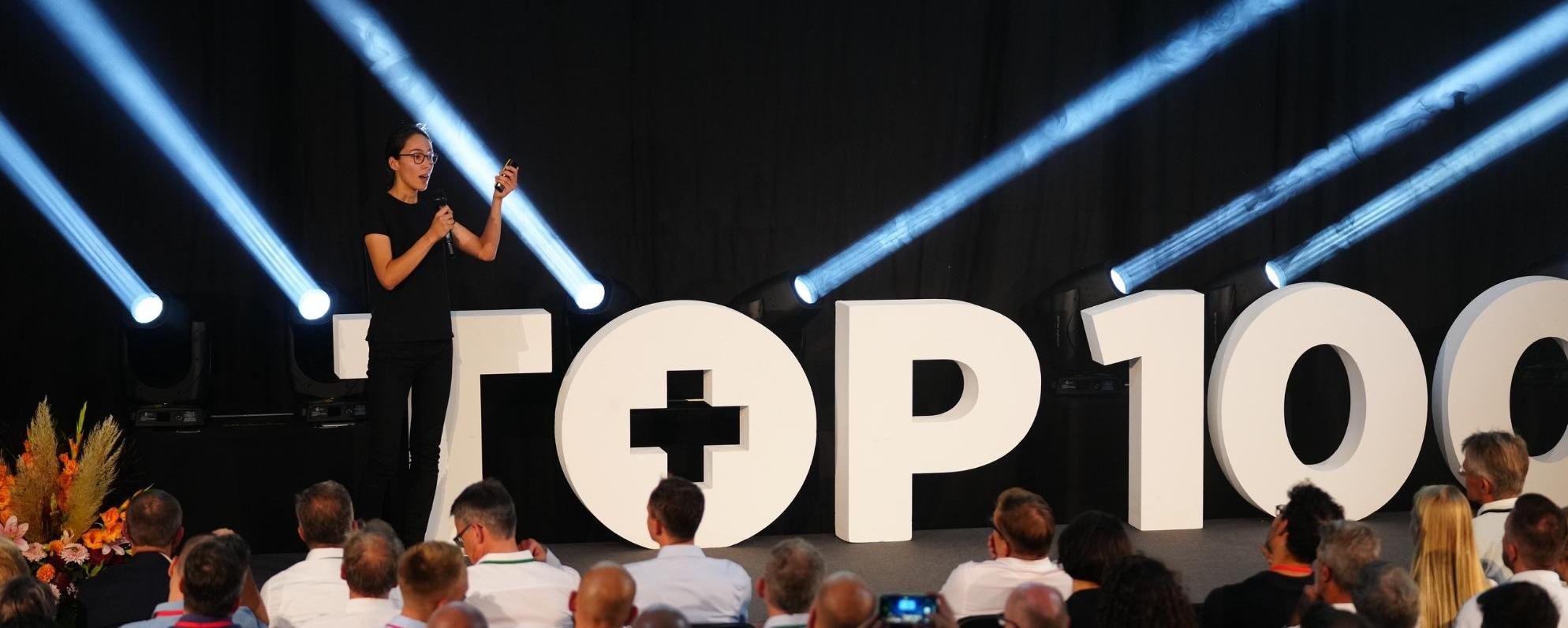
Ledgy ranks third at the TOP 100 Swiss Startup Award 2022
07.09.2022 20:32
Tracy Woodley
Bronze at the TOP 100 Swiss Startup Award goes to Zurich-based Ledgy. Ledgy is an equity management platform that helps high-growth companies manage their cap table, employee participation plans, funding rounds, and investor relations. Ledgy is used by leading companies such as Raisin, wefox, Frontify, Codility, Utopia, and many more to democratize startup equity by turning more than 6,000 employees into owners. The ICT startup was founded in 2017 by ETH Zurich physics graduates Yoko Spirig, Ben-Elias Brandt and Timo Horstschäfer and ranked 13th in 2021. Currently, 2,500 start-ups in 42 countries manage their share register on the Ledgy platform.

Time can hang heavy on the Trans-Siberian train from Vladivostok to Moscow. So at some point on their week-long journey to celebrate their physics degree, Yoko Spirig, Ben Brandt and Timo Horstschäfer started reading start-up books, among them Lean Startup by Eric Ries. Back in Zurich, the three set about putting their new knowledge into practice. The first business idea was in the direction of IT security. “We pursued it throughout our master’s studies,” says Spirig, today CEO of Ledgy.
They also contacted Doodle founders Paul Sevinç and Myke Näf via the now defunct platform cofoundme.ch. At one point, the two mentors brought up the topic of share registers for start-ups. Tracking shareholders can be a laborious process, particularly in the scale-up phase, as the shareholder base is in a constant state of flux. In addition to new investors, there are also employees who the company retains through shareholding programs.
A little market research among Sevinç and Näf’s acquaintances brought Spirig’s team together with Peter Käser, co-founder of VIU. He came to the first meeting with the Ledgy founders with a stack of Excel printouts and tales of nightmare scenarios. “That,” recalls Spirig, “was our ‘aha moment’.”
True to Ries’ lean start-up approach, the three physicists built a minimally viable product of a digital share register. They then went through the experimental phase with early adopters, including VIU’s CFO. The commercial launch took place at the beginning of 2020 and success came quickly.
Today, Ledgy has 2,500 customers in 42 countries. The main markets are the UK, France, Scandinavia, and the entire German-speaking region. A Series A funding round in September 2021, in which the world’s most renowned venture capital investor Sequoia participated, raised USD 10 million. Preparations are underway for the launch in the US.
Ledgy’s SaaS platform offers corporate customers a kind of Excel spreadsheet with a user interface. CFOs have the option of assigning authorizations to their shareholders or trustees or lawyers and allowing them to carry out transactions, such as transfers, independently in the share register. “Except for notarization, which is required for a capital increase,” says Spirig, “all processes are digitalized.”
Country-specific features are added to this basic offering. In the UK, for example, employee participation is limited to a certain amount. The British version of Ledgy knows this rule and warns the user if they break it.
Spirig describes herself and her two co-founders as “lateral entrants”. The start-up mentality is less pronounced in the Department of Physics than, for example, among mechanical or software engineers.
However, the three physicists have definitely arrived. The company is based in Kreis 5, a start-up ecosystem hotspot in Zurich. In the same office building are scale-ups Skribble, Beekeeper, and On Running. “One of our three neighbors is also one of our customers,” says Spirig. She is not allowed to say which one.
This article by Jost Dubacher was first published in the TOP 100 Swiss Startup Magazine 2022.