The 16 most promising medtech startups in 2022, according to investors
12.12.2022 09:00
Morgane Ghilardi
Medtech startups address the most pressing health issues of our time, reshaping and improving the quality of medical care and, thus, human lives. Swiss medtech companies attracted over CHF 370 million in 2022 so far, illustrating its relevance within the field of innovative technology endeavors. In September, the investors and industry experts that serve on the jury of the TOP 100 Swiss Startup Awards selected 16 young startups from the medtech sector.
 The TOP 100 Swiss Startup Award showcases the most promising Swiss startups. The annual ranking has become a benchmark in Switzerland’s startup ecosystem—and beyond.
Every year, a panel of 100 leading investors and startup experts chooses the 100 most innovative and promising Swiss startups. Each jury member nominates 10 Swiss startups that are less than five years old and show the greatest commercial potential. The first-placed company gets 10 points, the second nine points, and so on. The individual rankings are compiled to generate the final TOP 100 Swiss Startup Award ranking. In parallel, the TOP 100 Public Voting allows everyone with a LinkedIn account to cast one vote and choose the most promising startup per vertical.

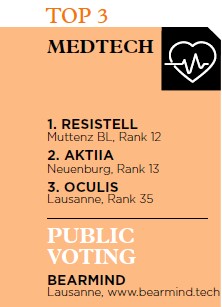
Resistell, #12
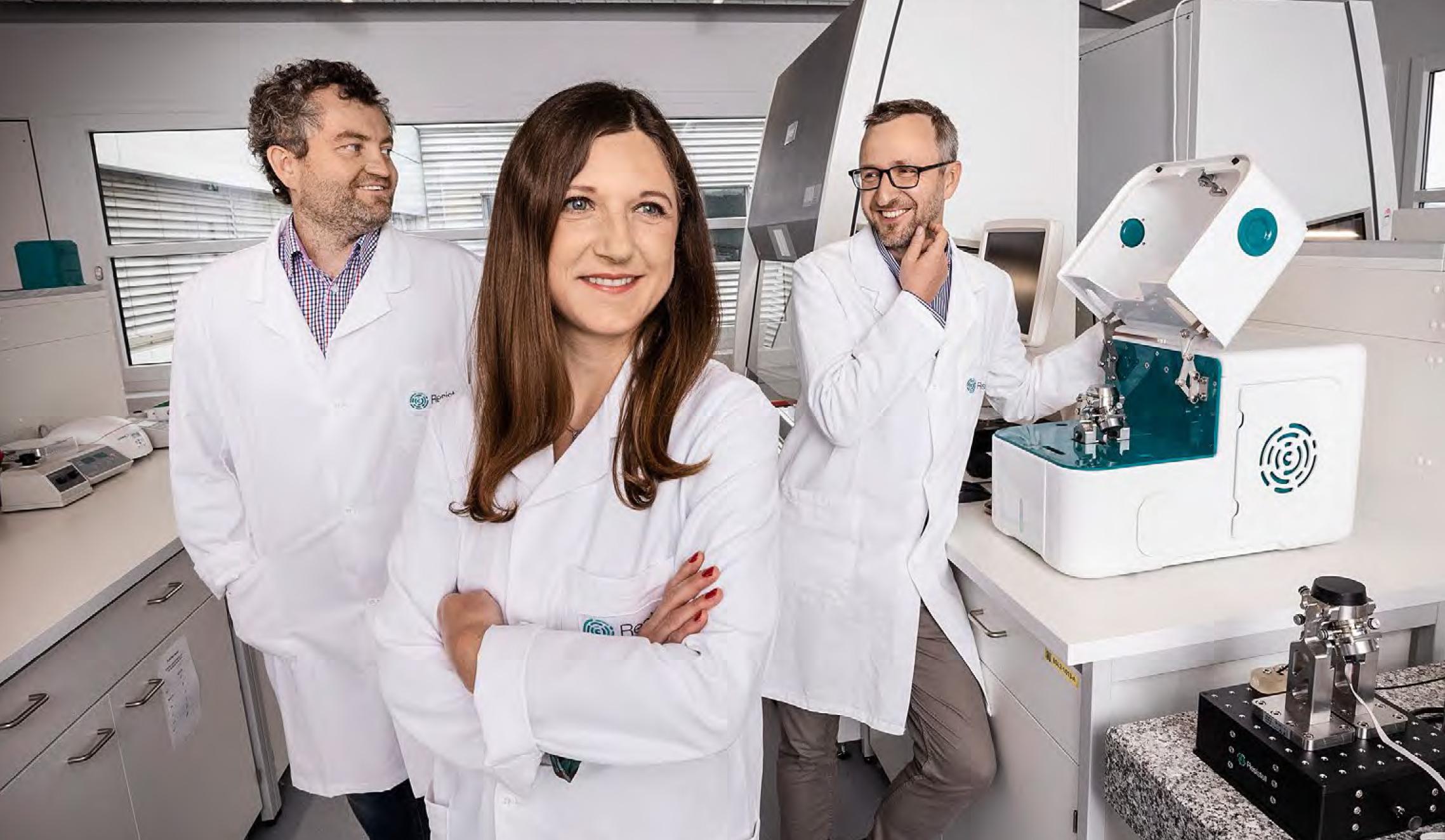
Basel startup Resistell has developed a nano motion-based technology platform for the analysis of cell metabolism. This means antibiotic sensitivity tests can be carried out much faster than before and thus more precise antibiotics are administered to counteract growing antibiotic resistance. A Series B financing round was launched this year and Resistell plans to use the funds to conduct clinical trials and develop next-generation devices. www.resistell.com
aktiia, #13
The blood pressure monitor in wristband form from aktiia is on the market in seven European countries just a year after receiving the CE mark. Several tens of thousands of devices are in use and now market entry in the US follows, where almost 50% of adults suffer from high blood pressure. In November, the CSEM spin-off raised more than USD 17.5 million in a funding round. www.aktiia.com
Volumina, #15
Volumina is active in the field of tissue engineering and develops injectable 3D scaffolds for the reconstruction of volumes of soft tissues (fat, muscles, glandular tissues, supporting and connective tissues) that have been lost after tumor ablation, disease, trauma, or for purely esthetically purposes. It addresses the lack of safe and efficient 3D repair and the needs of patients wanting to regain their physical and functional integrity. The company's first product targets breast reconstruction, where strenuous and repeated surgeries are currently standard. It represents a total market of CHF 3 billion. www.volumina-medical.ch
Oculis, #35
The Oculis team uses two technologies to treat eye diseases more effectively and easily: antibody fragments and nanoparticles. "We want to bring a broad range of innovative drugs to market for the three most common eye diseases: chronic dry eyes, retinal disease, and glaucoma," says CEO Riad Sherif, defining Oculis’ goal. The first candidate for the treatment of two different diseases is already in clinical phase 3, the last tests before approval. Thanks to the use of nanoparticles, OCS-1 may become the first drug in its indications that can be administered via eye drops rather than an injection and is thus an example of the benefits of nanotechnology in the medical field. However, progress is not easy to achieve—OCS-1 is the result of years of research by the founders. www.oculis.com
hemotune, #43
hemotune AG is developing a revolutionary medical device for blood purification that combines cutting-edge scientific results from biomedicine and nanotechnology. It allows specific and direct removal of disease-causing substances from the bloodstream of a patient. The technology targets a broad range of harmful compounds such as toxins, pathogenic organisms, or overdosed drugs. Being more targeted, efficient, and gentler than previous blood filters, hemotune outperforms state-of-the-art therapies and improves patient outcomes. Their first development candidate focuses on sepsis, a blood-spread infection with only very limited treatment options. www.hemotune.ch
Sleepiz, #47
Sleepiz developed a device that allows in-home monitoring of patients' sleep behavior to detect signs of disease. The device operates in a non-contact fashion, measuring movements originating from heart contractions as well as breathing patterns and body motions with medical-grade accuracy. The company registered Sleepiz One+—a device for the contactless measurement of respiration and heart rate—with the U.S. Food and Drug Administration (FDA) in July. Now, the company is joining the American Telehealth Association, a broad-based network of leading academic institutions, technology solution providers, investors, and healthcare institutions dedicated to advancing telemedicine in the United States. www.sleepiz.com
Positrigo, #55
The ETH spin-off developed the NeuroLF system, an ultra-compact and dedicated brain positron emission tomography (PET) system. PET imaging is a technique that uses positron-emitting radiopharmaceuticals to visualize and quantify various biochemical processes and is the diagnostic gold standard for evaluating neural structures relevant in detecting and diagnosing Alzheimer's and dementia. Currently available PET scanners are large and expensive, which limits the broader diffusion of PET technology. Positrigo’s NeuroLF system aims to overcome these barriers as the device is much smaller and less costly than full-body scanners. The company recently closed a series B funding round with CHF 5.5 million to proceed to commercialization.www.positrigo.com
Resmonics, #57
Resmonics is an award-winning ETH spin-off and a global market leader for acoustic artificial intelligence. Harnessing the power of sound for medicine, the company facilitates the detection and analysis of lung symptoms to warn patients about respiratory crises and infections in advance. Their first product is CE-certified software that enables medically meaningful cough analytics on smartphones. www.resmonics.ai
EBAMed, #60
Today, heart arrhythmia is treated with an invasive manual surgery requiring hours-long intervention via catheter from specialized staff and large costs. EBAMed's solution combines medical devices for proton therapy, motion tracking imaging, and software to enable the treatment of patients in a non-invasive way, in a single out-patient session, whilst increasing the patient throughput fivefold while saving costs. www.eba-med.com
Adiposs, #65
Adiposs is developing a disruptive first-in-class product for the detection of brown fat in cancer patients called ImageBAT. ImageBAT is a simple drink that patients take before their regular follow-up medical scan and predicts the response to immunotherapy. It's simple, fast, and pain-free. Cancer patients are spared the "trial and error" approach of cancer treatment, and are given a better chance of recovery. www.adiposs.com
IDUN Technologies, #70
IDUN Technologies is developing a neuro-intelligence platform designed to be a complete neurofeedback loop. The platform includes the development of brain-sensing hearables and respective biomarkers for measurement and quantification of cognitive and emotional states and a SaaS platform for processing, analyzing, interpreting, and accessing brain-wave data through API and actionable insights. www.iduntechnologies.com
Neurosoft Bioelectronics, #73
Neural implants are medical devices made of electrodes that can record or stimulate the brain, spinal cord, or peripheral nerves to monitor or treat patients suffering from neurological disorders. However, current clinical devices are too stiff compared to the soft tissues of the body, which limits benefits for patients. Neurosoft Bioelectronics developed a new generation of soft and conformable implantable electrodes that seamlessly interface with the nervous tissues and can improve clinical outcomes for patients. www.neurosoft-bio.com
Terapet, #77
Proton therapy is the most precise radiotherapy for cancer treatment. However, monitoring the doses during treatments remains a guessing game based on simulations. Terapet, a CERN startup, is developing a novel medical device that enables medical doctors for the first time to monitor the delivered proton dose inside the patients during cancer treatment: in-vivo, non-invasive, in 3D, and in real-time. This solution ensures that every patient receives the right dose, every time. www.terapet.ch
EarlySight, #80
EarlySight aims to reduce vision loss by enabling efficient detection and better monitoring of eye diseases. The company develops a high-performance eye imaging instrument empowering doctors to see the first disease impacts. About 25% of people over 60 years old in industrialized countries are affected by eye diseases. Most of these diseases—e.g., AMD or glaucoma—start with the degeneration of the retina's cellular structure, which can't be detected with current examinations, meaning they are diagnosed too late. EarlySight's proprietary eye imaging technology allows the observation of the tissue degenerative process associated with eye diseases, and detects its evolution, enabling early diagnosis, precise monitoring, and better treatments. www.earlysight.com
Lumendo, #84
Lumendo is a well-recognized upcoming disruptor in the field of endodontics. Focusing on product excellence and a strong innovation stream, Lumendo aims to revolutionize dental root canal treatments. The startup is an ETH and EPFL spinoff. www.lumendo.ch
Biospectal, #96
Biospectal's blood pressure measuring app OptiBP allows for safe, instant, ubiquitous, and accurate remote blood pressure monitoring and tracking. With a touch of the finger to a smartphone camera, anyone can transform their phone into a medical-grade blood pressure monitoring solution. www.biospectal.com
PUBLIC VOTING: Bearmind
Bearmind is an EPFL spin-off developing and commercializing in-built helmet sensors and software for brain injury prevention and performance monitoring in sports. The startup is developing sensors and algorithms to provide real-time concussion risk assessment. Their first product, currently being tested with Swiss National League clubs, combines helmet-integrated sensors and an analysis platform. The company is targeting professional ice hockey clubs with a solution to decrease the number of injuries and their insurance costs and optimize their players' performances. www.bearmind.tech